
If you’ve ever read a science textbook or seen chemistry videos, you might have come across the term “precipitates”.
But what does it really mean? Understanding precipitates meaning is important because it helps explain many chemical reactions we see in labs and even in daily life. Let’s break it down in simple words, with examples that make it easy to understand and remember.
What Are Precipitates? (Precise Definition)

A precipitate is a solid substance that forms in a liquid during a chemical reaction. It happens when two solutions react, and the new substance cannot dissolve in the liquid. Instead, it appears as particles or a layer at the bottom.
In short:
Precipitates are solids formed from liquids during chemical reactions.
How Precipitates Form
Precipitates form through a process called precipitation reaction, which happens when:
- Two soluble substances combine
- A product is insoluble in the liquid
- The solid separates from the solution
Example:
- Mix silver nitrate (AgNO₃) and sodium chloride (NaCl) in water
- Silver chloride (AgCl) forms as a white solid – this is the precipitate
- The remaining solution is clear
Common Types of Precipitates
Some common precipitates include:
- Silver chloride (AgCl) – white precipitate
- Barium sulfate (BaSO₄) – white precipitate used in medical imaging
- Lead iodide (PbI₂) – bright yellow precipitate
These examples are often used in chemistry labs to observe reactions clearly.
Precipitates Meaning in Chemistry
In chemistry, precipitates are solid particles that form in a liquid during a chemical reaction.
When two solutions react, a solid substance may appear and settle at the bottom. This solid is called a precipitate.
Example:
- Mixing silver nitrate and sodium chloride forms a white silver chloride precipitate.
Key Points
- Formed during chemical reactions
- Insoluble in the solution
- Often settles at the bottom of the container
Precipitate Meaning in Science
In science, precipitate generally means to cause something to happen suddenly or to form a solid from a liquid solution.
It can be used in different scientific fields.
Examples
- A chemical reaction may precipitate a solid compound.
- Sudden changes in the environment can precipitate events.
Precipitate Synonyms
Common synonyms for precipitate include:
- Trigger
- Cause suddenly
- Accelerate
- Bring about
- Induce
- Produce
- Spark
- Prompt
In chemistry context:
- Sediment
- Deposit
- Solid residue
Precipitates Meaning in Farsi
In Farsi (Persian), precipitate / precipitates can be translated as:
- رسوب (Rasub) – sediment or deposit
- تهنشین شدن – settling down
Example sentence:
- The reaction produced a white precipitate.
- واکنش یک رسوب سفید تولید کرد.
Precipitates Meaning in Chemistry
In chemistry, precipitates are solid substances that form when two liquids react together. These solids separate from the liquid solution and usually sink to the bottom of the container.
For example, when silver nitrate is mixed with sodium chloride, a white solid called silver chloride forms. That solid is called a precipitate.
Simple Chemistry Example
When two clear liquids are mixed:
- Liquid A + Liquid B → Solid forms
- The solid formed = precipitate
Chemists use precipitation reactions in laboratories to identify chemicals and separate substances.
Characteristics of a Precipitate
- Insoluble in the liquid
- Forms during a chemical reaction
- Often appears cloudy at first
- Can settle at the bottom
Precipitates Meaning in Farsi
The word precipitate in Farsi can be translated differently depending on the subject.
Common Farsi Meanings
- رسوب (Rasub) — used in chemistry for sediment or precipitate
- بارش (Baresh) — used for rain or weather precipitation
- عجولانه عمل کردن — used when someone acts quickly without thinking
So, the meaning changes based on whether the topic is science, weather, or behavior.
Precipitate Meaning in Science
In science, the word precipitate usually refers to something that forms suddenly or causes an event to happen quickly.
In chemistry and biology, it commonly means a solid formed from a liquid reaction. In environmental science, it may refer to materials separating from water.
Scientists also use the verb “precipitate” to describe causing something to happen unexpectedly.
Example Sentence
“The experiment precipitated a rapid chemical change.”
Precipitate Synonym
There are several synonyms for the word precipitate, depending on how it is used.
Synonyms for Precipitate (Verb)
- Cause
- Trigger
- Accelerate
- Rush
- Prompt
Synonyms for Precipitate (Noun)
- Sediment
- Deposit
- Residue
- Solid particle
Example
“The announcement precipitated panic in the market.”
Here, “triggered” can replace “precipitated.”
Precipitate Meaning in Medical
In medical language, precipitate means to suddenly cause a condition, reaction, or event to occur.
Doctors may say something “precipitated” an illness or symptom.
Medical Examples
- Stress can precipitate anxiety attacks.
- Certain foods may precipitate allergic reactions.
- Dehydration can precipitate dizziness.
The word is often used to describe a factor that quickly brings on a medical problem.
Precipitates Meaning Rain
In weather, precipitation refers to water falling from clouds to the Earth.
This includes:
- Rain
- Snow
- Hail
- Sleet
So when people say “precipitates meaning rain,” they are usually talking about precipitation in meteorology.
Types of Precipitation
| Type | Description |
|---|---|
| Rain | Liquid water droplets |
| Snow | Frozen ice crystals |
| Hail | Balls of ice |
| Sleet | Mix of rain and ice |
Precipitation is an important part of the Earth’s water cycle.
Precipitate Meaning in Biology
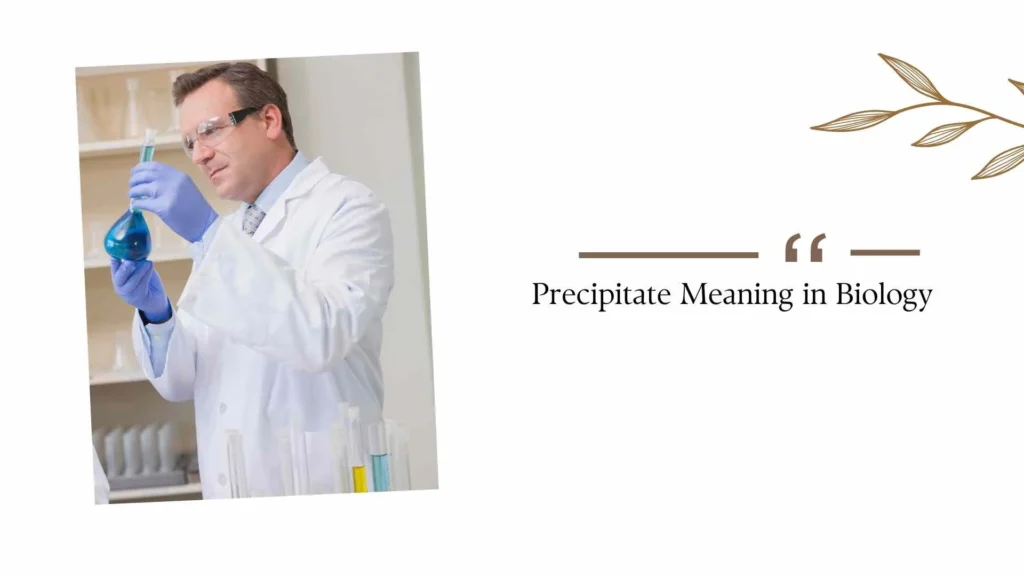
In biology, a precipitate forms when substances in a liquid combine and separate as solid particles.
Biologists often study protein precipitation in laboratories.
Biology Example
When certain proteins react with chemicals, they form visible solid particles called precipitates.
This process helps scientists analyze biological samples and identify substances.
Precipitated Meaning
The word precipitated is the past tense of precipitate. It means something was caused suddenly or forced to happen quickly.
Example Sentences
- Heavy stress precipitated the conflict.
- The reaction precipitated a white solid.
- The decision precipitated public protests.
The meaning depends on the situation, but it usually involves a sudden action or result.
Difference Between Precipitate and Precipitation
People often confuse these two terms, but they are slightly different.
| Word | Meaning |
|---|---|
| Precipitate | A solid formed in a chemical reaction or to cause something suddenly |
| Precipitation | Rain, snow, or any water falling from clouds |
Both words come from the same root but are used differently.
Why Is Precipitate Important in Chemistry?
Precipitates help scientists:
- Identify unknown chemicals
- Purify substances
- Study reactions
- Separate materials from solutions
Many laboratory experiments depend on precipitation reactions because they are easy to observe.
Everyday Use of Precipitate
Outside science, people use “precipitate” to describe actions done too quickly or events caused suddenly.
Everyday Examples
- A sudden rumor precipitated panic.
- His careless decision precipitated problems.
- Acting in a precipitate manner can lead to mistakes.
In this form, the word describes rushing or triggering something unexpectedly.
Precipitate Meaning in Medical Terms
In medical language, precipitate means to trigger or cause a condition or symptom to appear suddenly.
It often refers to factors that bring on a disease or medical episode.
Examples
- Stress can precipitate a migraine attack.
- Infection may precipitate heart problems.
Precipitates Meaning in Rain (Weather)
In meteorology, precipitation refers to water that falls from the atmosphere to the Earth.
Types of precipitation include:
- Rain
- Snow
- Sleet
- Hail
So in weather, precipitates means water particles falling from clouds.
Precipitate Meaning in Biology
In biology, precipitate can mean a substance that separates out of a liquid and forms a solid during biological or biochemical reactions.
This often occurs in:
- Protein reactions
- Antigen-antibody reactions
- Laboratory testing
Example
- Some proteins precipitate when heated or when chemicals are added.
Precipitating Factor Meaning
A precipitating factor is something that directly triggers or causes an event, condition, or disease to start.
It is commonly used in medicine, psychology, and science.
Examples of precipitating factors
- Stress causing anxiety attacks
- Infection triggering illness
- Trauma leading to mental health issues
Simple Definition:
A precipitating factor is the immediate cause that brings about a problem or event.
Why Are Precipitates Important?
Understanding precipitates meaning is more than memorizing definitions. They are important because they:
- Help identify unknown substances
- Show whether a reaction has occurred
- Are used in real-life applications like water purification and drug production
Example in daily life:
- Hard water can create limescale, which is basically a precipitate of calcium salts.
How to Recognize a Precipitate
You can identify a precipitate when:
- The solution becomes cloudy or milky
- Solid particles appear at the bottom
- The liquid separates from the solid
These signs help chemists confirm that a chemical reaction has happened.
Common Questions About Precipitates

Q1: Is a precipitate always visible?
- Usually yes, but some are very fine and look like slight cloudiness.
Q2: Can all solids in liquids be called precipitates?
- No, a precipitate forms specifically from a chemical reaction, not just by cooling or evaporation.
Q3: Is precipitation reversible?
- Sometimes. Some precipitates can dissolve again in water or other solvents under certain conditions.
Conclusion
Understanding precipitates meaning helps simplify chemistry and makes it easier to see how substances react in liquids.
If it’s in a lab experiment or everyday life, recognizing precipitates allows you to understand chemical changes more clearly. Next time you see a solid forming in a solution, you’ll know exactly what’s happening!

Charlotte Davis
Hello! I’m Charlotte Davis, a lifelong explorer of words and stories. Ever since I can remember, I’ve been fascinated by how language shapes our thoughts and feelings. Writing for me is more than a passion—it’s a way to connect with readers around the world and share perspectives that inspire and provoke curiosity. I love diving into both fiction and non-fiction, always seeking stories that leave a mark. When I’m not writing, you’ll find me reading, traveling, or simply observing life’s small wonders. Through my work, I hope to bring meaning, joy, and reflection to everyone who reads it.
Books:
-
Echoes of Tomorrow
-
Whispers in the Wind